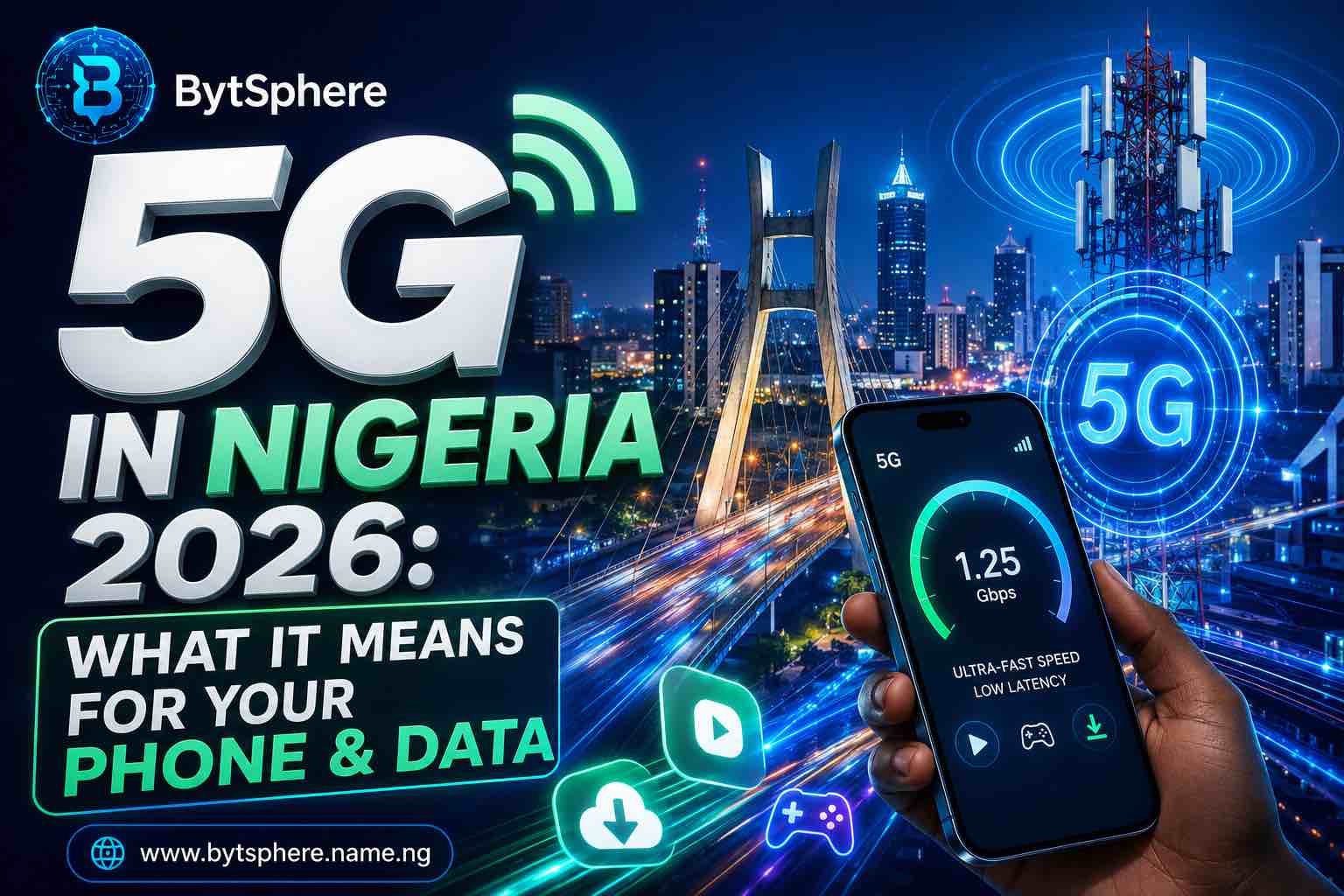
5G has been the most talked-about technology in Nigerian telecom circles since MTN first flipped the switch in Lagos back in September 2022. Four years later, the hype is still loud — but the reality on the ground is more nuanced than the advertisements suggest.
📋 Table of Contents
- What Exactly Is 5G?
- Where Is 5G Available in Nigeria Right Now?
- MTN vs Airtel 5G: Which Is Better?
- How Fast Is 5G in Nigeria Really?
- Which Phones Support 5G in Nigeria?
- Does Your SIM Card Support 5G?
- How to Enable 5G on Your Phone
- Should You Upgrade to 5G in 2026?
- The Future of 5G in Nigeria
- Frequently Asked Questions
In 2026, 5G in Nigeria is real, growing, and genuinely impressive in the places it works. But it is not yet a national technology — and millions of Nigerians with 5G-capable phones still can't connect to it because the network simply isn't where they live.
So what does 5G actually mean for your phone, your data, and your daily life in Nigeria right now? Let's break it down — honestly, practically, and in plain language.
1. What Exactly Is 5G?
5G is the fifth generation of mobile network technology — the successor to 4G LTE that most Nigerians currently use. Each generation of mobile network has brought significant improvements over the last, and 5G is the biggest leap yet.
- 2G (launched 1992) — basic calls and SMS. Still used in some rural Nigerian areas today.
- 3G (launched 2001) — introduced mobile internet. Slow browsing, basic social media.
- 4G LTE (launched in Nigeria around 2013) — fast mobile internet, HD video streaming, video calls. The current standard for most Nigerians.
- 5G (launched in Nigeria September 2022) — ultra-fast speeds, extremely low latency, capacity for thousands of connected devices simultaneously.
In technical terms, 5G promises speeds up to 10 times faster than 4G, latency up to 50 times lower, and the ability to connect far more devices simultaneously in one area. In practical terms for Nigerians — think downloading a full HD movie in seconds, gaming online with zero lag, and video calls so smooth they feel in-person.
2. Where Is 5G Available in Nigeria Right Now?
This is the most important question — and the honest answer is that 5G is concentrated in urban areas, specifically the commercial cores of major cities.
MTN 5G currently operates over 2,100 active 5G sites across 13 cities in Nigeria — the largest 5G footprint in the country. Cities with MTN 5G coverage include Lagos, Abuja, Port Harcourt, Kano, Ibadan, Owerri, Onitsha, and several other economic hubs.
Airtel 5G has rolled out to 20 cities in 2026, focusing on balancing performance with affordability in urban and suburban areas.
How to check if 5G is available at your exact location:
- MTN: Visit coverage.mtn.ng and enter your specific address — it's the most accurate coverage checker available for Nigerian users
- Airtel: Call 111 from your Airtel line and ask customer service to confirm 5G availability at your location
- Independent check: Download the Ookla Speedtest app or nPerf app — both show real-world network performance data based on actual user tests in your area, not theoretical coverage maps
- On your phone: On a 5G-capable device, go to Settings → About Phone → Network to see which bands your phone is connected to
What about Glo and 9mobile? Glo is actively rolling out 5G but coverage remains very limited in 2026. 9mobile is focused primarily on optimising its 4G LTE network for now and is not a meaningful 5G option.
3. MTN vs Airtel 5G: Which Is Better in Nigeria?
- MTN 5G — Best for coverage and raw speed. MTN has the widest 5G coverage in Nigeria with over 2,100 active sites across 13 cities. Average download speeds in urban areas consistently top 100Mbps. MTN is the best 5G option for professionals, gamers, and heavy streamers who need the lowest latency and fastest speeds. MTN is best if you travel frequently across Nigeria — their overall network has the deepest penetration, including rural areas.
- Airtel 5G — Best for city users who want value. Airtel has rolled out to 20 cities and their 4G LTE network is arguably the most stable in suburban areas. Their "Binge" plans and weekly bundles offer excellent value, making Airtel popular among students and young professionals. While their 5G footprint is slightly behind MTN in total sites, their pricing and customer service (including AI-powered support) make them very competitive in urban areas.
4. How Fast Is 5G in Nigeria Really?
Here's the part that matters most to everyday Nigerian users — what does 5G actually feel like compared to what you're used to?
- MTN 5G in a strong coverage zone: average download speeds of 100Mbps–300Mbps. In optimal conditions, speeds can exceed 500Mbps — fast enough to download a full HD film in under 30 seconds.
- MTN 4G LTE (current standard): average download speeds of 25–50Mbps in good coverage areas — already more than sufficient for HD streaming and video calls.
- 5G Fixed Wireless Broadband: Airtel is specifically targeting businesses in 2026 with 5G fixed wireless internet — delivering over 500Mbps download speeds as an alternative to fibre, with far faster installation times.
5. Which Phones Support 5G in Nigeria?
Not all smartphones support 5G — your phone needs a 5G-compatible modem chip to connect to the network. Here's a breakdown of popular phones in Nigeria and their 5G status:
iPhones with 5G support:
- iPhone 12, 12 Mini, 12 Pro, 12 Pro Max and all newer models
- iPhone 13, 14, 15, 16 series — all 5G compatible
- iPhone 11 and older — NO 5G support
Android phones with 5G support:
- Samsung Galaxy A54, A55, A34, S23, S24, S25 series
- Tecno Pova 6 Pro 5G, Tecno Spark 30 5G
- Infinix Note 40 Pro 5G, Infinix GT 20 Pro
- Xiaomi Redmi Note 13 Pro 5G, Poco X6 Pro
- Most flagship and upper mid-range Android phones from 2023 onwards
Popular phones without 5G support:
- Tecno Spark 40, Spark 30 (standard) — 4G only
- Infinix Hot 40, Note 60 Pro (standard) — 4G only
- iPhone 11 and older — 4G only
- Most budget Android phones under ₦150,000 — 4G only
6. Does Your SIM Card Support 5G?
Having a 5G phone is only half the equation — your SIM card also needs to support 5G. Newer SIM cards issued from 2022 onwards on MTN and Airtel are generally 5G-ready. Older SIMs may require an upgrade.
- MTN: Visit any MTN service centre with a valid ID and request a free SIM upgrade. Newer MTN SIM cards already support 5G — check with an agent to confirm yours does.
- Airtel: Visit an Airtel experience centre or call 111 to request a SIM upgrade. The process is free and your number stays the same.
- Quick test: If your 5G phone shows 5G in the network settings but your phone keeps falling back to 4G in a covered area, your SIM may be the issue — upgrade it first before troubleshooting further.
7. How to Enable 5G on Your Android Phone
Even if you have a 5G phone and a 5G SIM in a covered area, 5G may not be enabled by default on your device. Here's how to turn it on:
- Go to Settings → Mobile Network (or "SIM & Network" on some phones)
- Tap on your SIM card (MTN or Airtel)
- Tap "Preferred Network Type" or "Network Mode"
- Select "5G/4G/3G/2G (Auto)" or simply "5G" if that option is available
- Your phone will now connect to 5G automatically when you're in a covered area
For iPhone users: Go to Settings → Mobile Data → Mobile Data Options → Voice & Data and select 5G Auto or 5G On.
8. Should You Upgrade to a 5G Phone in 2026?
This is the practical question most Nigerians are asking — and the honest answer depends on where you live and what you do.
Upgrade to a 5G phone if:
- You live or work in Lagos, Abuja, Port Harcourt, Kano, or Ibadan — where 5G coverage is most developed
- You are already in the market for a new phone and can find a 5G model within your budget
- You work from home, do heavy video streaming, gaming, or run a business that depends on fast internet
- You want to future-proof your phone purchase — 5G coverage will only expand over the next 3–4 years
Don't rush to upgrade if:
- You live in a rural area or smaller city not yet covered by 5G — you'll pay more for a feature you can't use
- Your current 4G phone is working well and you're not due for an upgrade
- Budget is tight — decent 5G Android phones start from around ₦280,000–₦350,000 in Nigeria
- You mainly use your phone for calls, WhatsApp, and social media — 4G is more than sufficient for these
9. The Future of 5G in Nigeria
The current state of 5G in Nigeria — real but limited — is set to change significantly over the next few years. Here's what the data says about where things are heading:
- Coverage expansion to top 20 cities by 2029 — based on verified operator plans and NCC spectrum commitments, 5G will be meaningfully available across the majority of Nigeria's top 20 cities within three years.
- From 13% to 50% coverage by 2030 — Nigeria's NCC Spectrum Roadmap for 2026–2030 targets increasing national 5G coverage from the current 13% to 50%, using a combination of new base stations and satellite-to-phone technology.
- Satellite-to-phone integration — the NCC is actively pursuing direct satellite-to-phone service (similar to what Starlink is developing globally) to extend high-speed internet to rural Nigeria where traditional towers are uneconomical to build.
- Phase-out of 2G and 3G — eliminating legacy 2G and 3G networks will free up crucial spectrum for 4G and 5G expansion. This transition is already underway and will accelerate through 2027–2028.
- 5G fixed wireless broadband — businesses in covered areas will increasingly replace slow fibre connections with 5G fixed wireless, which can deliver 500Mbps+ with same-day installation.
Final Thoughts
5G in Nigeria in 2026 is real, but it's a story of two Nigerias — the urban cores of Lagos, Abuja, and a handful of other cities where 5G is already delivering genuinely impressive speeds, and the rest of the country where 4G LTE remains the practical reality for years to come.
The most important thing to understand is this: don't buy a phone based on 5G hype alone. Check whether 5G actually covers your specific location first. If it does, and you're in the market for a new phone, choosing 5G is a smart long-term investment. If it doesn't, a great 4G phone will serve you just as well for now.
Are you on 5G in Nigeria right now? Drop a comment below and tell us your city and which network you're on — and whether the speeds live up to the hype!
Stay tuned to BytSphere for more honest tech guides made for Nigerians.
Frequently Asked Questions
Is 5G available in my city in Nigeria?
MTN currently has 5G in 13 cities including Lagos, Abuja, Port Harcourt, Kano, Ibadan, Owerri, and Onitsha. Airtel has rolled out to 20 cities in 2026. However, even within these cities, coverage is concentrated in urban cores and commercial zones. The most reliable way to check is to visit coverage.mtn.ng and enter your exact address, or call Airtel on 111 to verify coverage at your specific location.
Will 5G make my data more expensive in Nigeria?
Not necessarily. MTN and Airtel have largely kept 5G data pricing in line with their 4G plans — you're paying for the same data, just getting faster speeds where 5G is available. However, as 5G expands and becomes the standard, data plans may be restructured. For now, switching to 5G (if your phone and location support it) doesn't require purchasing a different or more expensive data plan on most networks.
Does 5G drain phone battery faster?
Yes — 5G uses more power than 4G, particularly when actively streaming or downloading at high speeds. However, modern 5G phones (from 2022 onwards) are designed with larger batteries and more efficient chips to compensate. The practical solution is to use "5G Auto" mode rather than "5G Only" — this lets your phone automatically switch between 5G and 4G based on signal strength and activity, which is significantly more battery-efficient than staying locked to 5G at all times.
Is 5G safe? Does it cause health problems?
Yes, 5G is safe. The World Health Organization (WHO), the International Commission on Non-Ionizing Radiation Protection (ICNIRP), and every major global health authority have reviewed the scientific evidence and concluded that 5G radio frequencies, at the power levels used by mobile networks, pose no health risk to humans. 5G uses non-ionizing radio waves — the same fundamental type of radio frequency used by 4G, Wi-Fi, and radio broadcasts for decades. The health concerns circulated on Nigerian WhatsApp groups about 5G are misinformation with no scientific basis.
Can I use 5G on my current MTN or Airtel SIM?
Newer SIM cards issued from 2022 onwards on MTN and Airtel generally support 5G. If your SIM is older, you may need a free upgrade. For MTN, visit any MTN service centre with a valid ID and request an upgrade — your number stays the same. For Airtel, call 111 or visit an Airtel experience centre. If you have a 5G phone in a covered area but your phone keeps showing 4G, an outdated SIM is often the reason.
What is the cheapest 5G phone available in Nigeria in 2026?
The most affordable 5G phones available in Nigeria in 2026 start from around ₦280,000 – ₦350,000. Options include the Tecno Spark 30 5G, Infinix Note 40 Pro 5G, and entry-level 5G Samsung Galaxy models. For iPhones, the cheapest 5G option is a clean UK-used iPhone 12, which can be found from around ₦280,000 – ₦350,000 at Computer Village. Always verify the phone is unlocked and test it with your SIM before purchasing.
📱 You Might Also Like
- How AI Is Already Changing Everyday Life in Nigeria in 2026
- iPhone vs Tecno: Which Should a Nigerian Buy in 2026?
- Infinix Note 60 Pro Review: Is It the Best Mid-Range Phone in Nigeria?
- 10 Android Tips Every Tecno & Infinix User Should Know in 2026
- How to Save Data on Android for MTN, Airtel & Glo Users