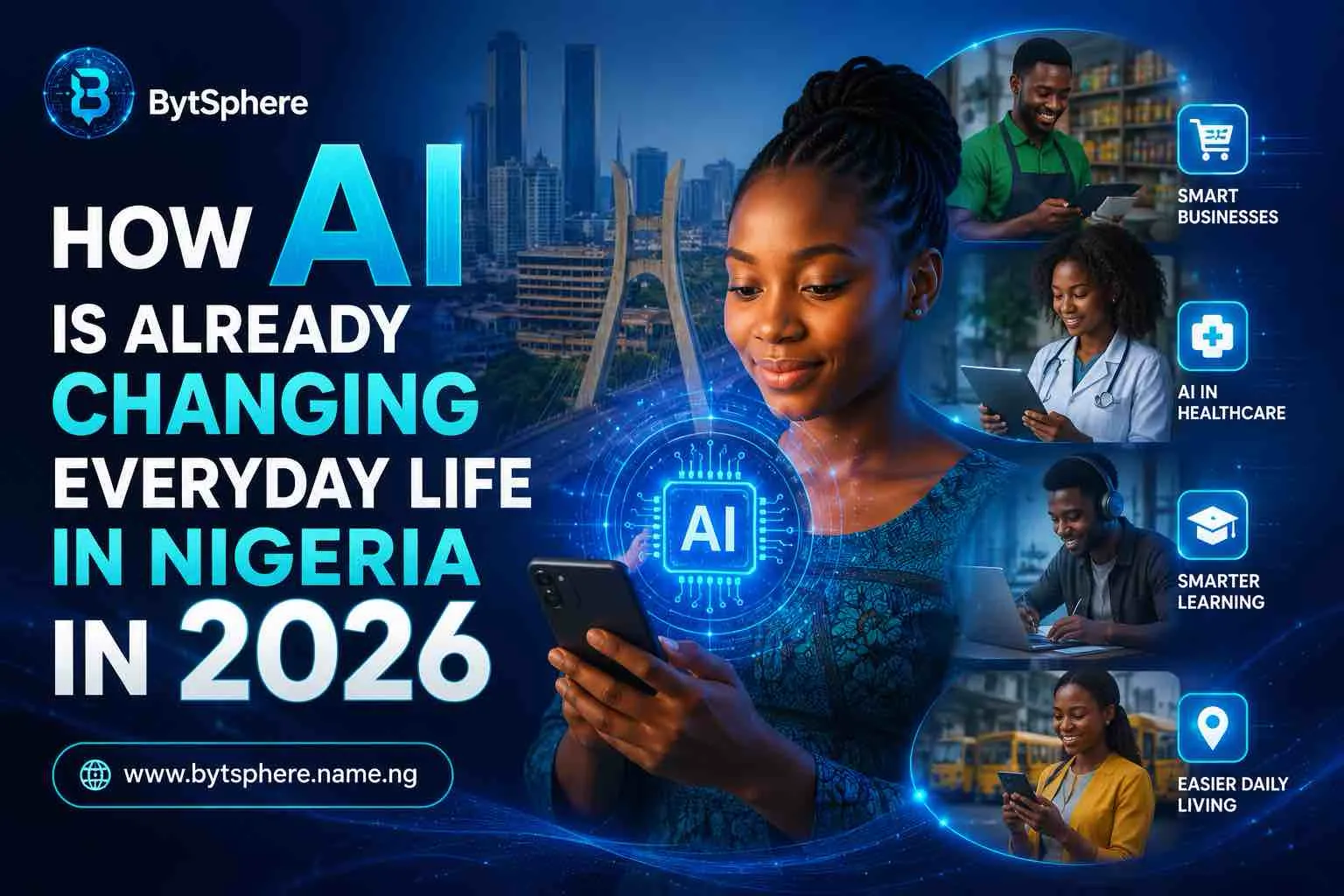
Not long ago, "Artificial Intelligence" sounded like something out of a Hollywood sci-fi film — robots, self-driving cars, and supercomputers making decisions for humanity. Most Nigerians thought it had nothing to do with their daily lives.
That thinking is now dangerously outdated.
📋 Table of Contents
In 2026, AI is no longer coming to Nigeria — it is already here. It's in the bank app you used to transfer money this morning. It's in the WhatsApp chatbot your bank uses for customer service. It's helping farmers in Kaduna predict rainfall. It's detecting fake news on social media. And it's sitting right there in the phone in your pocket, powering your keyboard, your camera, and your Google Maps directions.
Whether you work in banking, farming, education, or run a small business — AI is reshaping your world. Here's exactly how.
1. AI in Your Bank & Fintech Apps
This is where most Nigerians are already experiencing AI daily — without realizing it. Nigerian banks and fintech companies are among the most aggressive AI adopters on the continent.
UBA's Leo Chatbot is one of the most used AI tools in Nigeria. Millions of Nigerians already use Leo on WhatsApp and Facebook Messenger to check account balances, transfer money, buy airtime, and pay bills — all by simply typing a message, without visiting a bank or opening an app. Leo understands plain English and even Nigerian Pidgin.
But AI in Nigerian banking goes much deeper than chatbots:
- Fraud detection in real time — AI monitors every transaction on your account and flags unusual activity instantly, often blocking fraudulent transfers before they complete
- Alternative credit scoring — instead of asking for payslips and collateral, AI now analyses your phone usage, spending patterns, and transaction history to determine if you qualify for a loan. This is how apps like Carbon, FairMoney, and Branch give instant loans in minutes
- Smart customer service — most bank websites and apps now use AI-powered chatbots that handle thousands of customer enquiries simultaneously, 24 hours a day
- Personalised financial insights — apps like PiggyVest and Cowrywise use AI to analyse your spending habits and suggest smarter saving strategies
2. AI Is Already on the Phone in Your Hand
You don't need to download any special AI app to experience artificial intelligence — it's already built into your Android or iPhone. Every time you use your phone, you're using AI.
- Autocorrect & predictive text — the keyboard that guesses your next word before you type it is powered by AI. It learns your writing style over time and gets smarter the more you use it.
- Google Maps & traffic prediction — when Google Maps tells you to avoid Oshodi at 5pm because of heavy traffic, that's AI analysing real-time data from millions of phones and predicting congestion before it peaks.
- Camera scene detection — when your phone's camera automatically adjusts settings for food, landscapes, or portraits, that's AI recognising the scene and optimising the shot in milliseconds.
- YouTube & TikTok recommendations — the reason you can spend 3 hours on TikTok without running out of content is AI. It learns exactly what keeps you watching and serves more of it continuously.
- Voice assistants — Google Assistant, Siri, and Samsung's Bixby use AI to understand natural language, answer questions, set reminders, and control your phone with your voice.
- ChatGPT on Android — ChatGPT is now the #1 downloaded Android app in Nigeria. Millions of Nigerians are using it daily for writing, research, business planning, coding, and problem-solving.
3. AI in Nigerian Healthcare
Nigeria's healthcare system faces real challenges — too few doctors, overcrowded hospitals, and millions of Nigerians in rural areas with no access to medical facilities at all. AI is beginning to fill these gaps in ways that would have seemed impossible five years ago.
- Ubenwa — a Nigerian AI app that analyses a baby's cry to detect signs of birth asphyxia. By listening to the sound patterns of a newborn's cry, it can predict whether the baby needs urgent medical attention — potentially saving lives in areas with no immediate doctor access
- AI-powered diagnostics — machine learning algorithms can now analyse medical scans (X-rays, MRIs) and detect conditions like tuberculosis, cancer, and diabetic retinopathy with accuracy that rivals experienced radiologists
- Telemedicine chatbots — platforms like HealthConnect247 use AI to handle preliminary medical consultations, symptom checking, and appointment scheduling — reducing pressure on overwhelmed hospitals
- Drug supply chain management — AI is helping Nigerian pharmaceutical companies predict drug shortages and optimise distribution to ensure essential medicines reach the right hospitals at the right time
4. AI on Nigerian Farms
Agriculture employs over 35% of Nigeria's workforce, yet many farmers still use traditional methods that limit productivity and leave them vulnerable to crop failure. AI is quietly transforming Nigerian farming — and the results are significant.
Zenvus is a Nigerian AI system that places sensors directly in farmland to measure soil nutrients, moisture levels, and weather conditions. It then uses machine learning to predict rainfall and recommend the best time to plant, irrigate, and harvest — giving small-scale Nigerian farmers access to the kind of precision data that large agricultural corporations pay millions for.
- Crop disease detection — farmers can now photograph their crops with a smartphone and use AI apps to identify diseases and pests within seconds, before they spread and destroy the harvest
- Rainfall & weather prediction — AI models analyse satellite data to give farmers in Kano, Benue, and Plateau State accurate rainfall predictions weeks in advance, helping them plan planting schedules
- Smart irrigation — AI-powered irrigation systems monitor soil moisture and automatically water crops only when needed, reducing water waste significantly
- Market price prediction — AI tools now help Nigerian farmers predict commodity prices before harvest, so they can decide when to sell for maximum profit instead of selling at whatever price middlemen offer
5. AI in Nigerian Education
The Nigerian EdTech market is expected to surpass $400 million in 2026, and AI is at the heart of this explosion. Platforms like uLesson, AltSchool Africa, and Prepclass are using AI to personalise learning for Nigerian students in ways that traditional classrooms simply cannot.
- Personalised learning paths — AI analyses a student's performance, identifies weak areas, and automatically adjusts lesson difficulty and pacing to match their individual learning speed
- AI tutors available 24/7 — students no longer have to wait until the next school day to get help with a difficult topic. AI tutors on platforms like uLesson answer questions instantly at any time of day or night
- Automated grading — AI can grade multiple-choice tests, essays, and assignments instantly, freeing up teachers to focus on actual teaching instead of paperwork
- Exam preparation — AI-powered WAEC, JAMB, and NECO prep platforms analyse past question patterns and predict likely exam topics, giving Nigerian students a smarter revision strategy
6. AI & the Future of Nigerian Jobs
This is the question on everyone's mind — and the honest answer is nuanced. AI is both threatening some jobs and creating entirely new ones at the same time.
Jobs at risk from AI in Nigeria:
- Basic data entry and document processing roles
- Routine customer service positions being replaced by chatbots
- Simple accounting and bookkeeping tasks now handled by AI tools
- Basic graphic design being disrupted by AI image generators
- Repetitive legal document review and drafting
Jobs being created or growing because of AI:
- AI prompt engineers — professionals who know how to write effective instructions for AI tools to get the best results
- Data analysts & scientists — Nigeria's most in-demand tech skill in 2026, with salaries ranging from ₦800,000 to ₦3,000,000+ monthly
- AI content creators — those who use AI tools to produce content faster and better are outcompeting those who don't
- Cybersecurity specialists — as AI creates new threats, it also creates massive demand for those who can defend against them
- AI trainers & evaluators — Nigerians are being hired globally to evaluate AI outputs, with companies like OpenAI, Scale AI, and others actively recruiting Nigerian talent
"As we enter 2026, AI will replace some skills and create new ones. Professionals who do not develop their AI capacity will be replaced by those who do." — Dotun Adeoye, AI in Nigeria Co-founder
7. Free AI Tools Every Nigerian Should Be Using Right Now
You don't need to understand how AI works to benefit from it. These tools are free, accessible on any smartphone, and immediately useful for everyday Nigerian life:
- ChatGPT (chat.openai.com) — write emails, business proposals, CVs, social media captions, study notes, code, and almost anything else. The free version is powerful enough for most everyday tasks.
- Google Gemini — integrated directly into Google Search and available as a standalone app. Great for research, summarising long documents, and answering complex questions in plain language.
- Microsoft Copilot — free AI assistant built into Windows and available via browser. Excellent for students and professionals using Word, Excel, and PowerPoint.
- Canva AI (canva.com) — generate images, design social media posts, write marketing copy, and create presentations using AI — all for free. Essential for Nigerian entrepreneurs and content creators.
- Dubawa WhatsApp Chatbot — Nigeria's AI-powered fact-checking tool. Send any viral news story to the Dubawa chatbot on WhatsApp and it will tell you if it's true or false. Critical in Nigeria's fake news environment.
- Otter.ai — automatically transcribes meetings, voice notes, and audio recordings into text. Useful for journalists, students, and business professionals.
8. Challenges Nigeria Still Faces With AI
The AI revolution in Nigeria is real — but it's not without significant obstacles that need honest discussion.
- Infrastructure gaps — AI requires reliable internet and electricity. With Nigeria's inconsistent power supply and patchy internet coverage outside major cities, millions of Nigerians are currently excluded from AI's benefits
- Digital skills gap — only 8.2% of Nigerians are actively using AI tools, compared to Kenya's 42.1%. Awareness and digital literacy remain major barriers
- No binding AI law yet — Nigeria's National AI Strategy is still in draft form. Without regulation, there are real risks around data privacy, algorithmic bias, and AI-powered fraud
- Brain drain — Nigeria trains talented AI engineers who are quickly hired by international companies, creating a persistent local talent vacuum
- Language barriers — most AI tools are optimised for English. Nigerian languages like Yoruba, Igbo, and Hausa are underrepresented in AI training data, limiting accessibility for a large portion of the population
📱 You Might Also Like
- How to Use ChatGPT on Your Android Phone Without a VPN in Nigeria
- How to Make Money Online in Nigeria Using AI Tools in 2026
- 10 Android Tips Every Tecno & Infinix User Should Know in 2026
- iPhone vs Tecno: Which Should a Nigerian Buy in 2026?
- 5G in Nigeria: What It Means for Your Phone & Data in 2026
9. What This All Means for You
The AI revolution is not a distant future event for Nigeria — it is the present reality. The question is no longer whether AI will affect your life. It already is. The only question is whether you will actively use it to your advantage, or passively let it reshape your world without your input.
The good news is that the barrier to entry has never been lower. The most powerful AI tools in the world — ChatGPT, Google Gemini, Canva AI, Microsoft Copilot — are available for free, right now, on the phone in your pocket.
Which area of AI are you most interested in exploring? Drop a comment below — and share this post with someone who still thinks AI has nothing to do with their life!
Stay tuned to BytSphere for more practical AI guides made for Nigerians.
Frequently Asked Questions
Is AI available in Nigeria right now or is it still coming?
AI is already in Nigeria — right now, today. You are almost certainly already using it without realising it. Every time you use Google Maps, get a loan from Carbon or FairMoney, receive a recommendation on YouTube or TikTok, or chat with your bank's WhatsApp bot, you are using AI. ChatGPT is now the most downloaded Android app in Nigeria. AI is not coming — it arrived.
Do I need to be tech-savvy to use AI tools in Nigeria?
Not at all. The most powerful AI tools — ChatGPT, Google Gemini, and Canva AI — are designed for everyday users with no technical background. If you can type a message on WhatsApp, you can use ChatGPT. You simply type what you want in plain English (or even Pidgin), and it responds. No coding, no technical skills, no special training required. Start with ChatGPT at chat.openai.com — it's completely free.
Will AI take my job in Nigeria?
AI will automate some tasks, but it's more accurate to say AI will change jobs rather than simply eliminate them. Routine, repetitive tasks are most at risk — basic data entry, simple customer service, and repetitive document processing. However, AI is simultaneously creating new roles in data analysis, AI training, content creation, cybersecurity, and prompt engineering. The safest position is to learn how to use AI tools in your current role — making yourself more productive rather than replaceable. Those who use AI will have an advantage over those who don't, not the other way around.
What is the Nigerian government doing about AI?
The Nigerian government is actively pursuing an AI strategy. NITDA (National Information Technology Development Agency) has published a National AI Strategy (NAIS) and launched the free 3MTT (Three Million Technical Talent) programme to train Nigerians in AI, data analytics, and cloud computing. Over 106,000 Nigerians have already completed training. The government is also working on AI regulation to govern data privacy, algorithmic transparency, and ethical AI use. Enroll for free at 3mtt.nitda.gov.ng.
How can I protect myself from AI-powered scams in Nigeria?
AI scams in Nigeria are growing fast. Key protections: (1) Never send money based on a voice call or video alone — AI can now clone voices and faces with high accuracy. Always verify through a separate channel. (2) Be sceptical of viral videos of public figures making surprising announcements — deepfakes are increasingly convincing. (3) Use Dubawa's WhatsApp fact-checker to verify news before sharing. (4) Never click links in unsolicited WhatsApp messages promising loans, prizes, or government benefits. When in doubt, verify directly with the official organisation.
Is ChatGPT free to use in Nigeria?
Yes — ChatGPT's free tier is available to all Nigerians at chat.openai.com or via the ChatGPT app on Android and iOS. The free version gives you access to GPT-4o mini, which is powerful enough for most everyday tasks — writing, research, summarising, answering questions, and more. A paid ChatGPT Plus subscription ($20/month) gives access to the most powerful model, but the free version is an excellent starting point. You can pay for Plus using a Naira Mastercard or virtual dollar card from providers like Chipper Cash or Grey.