
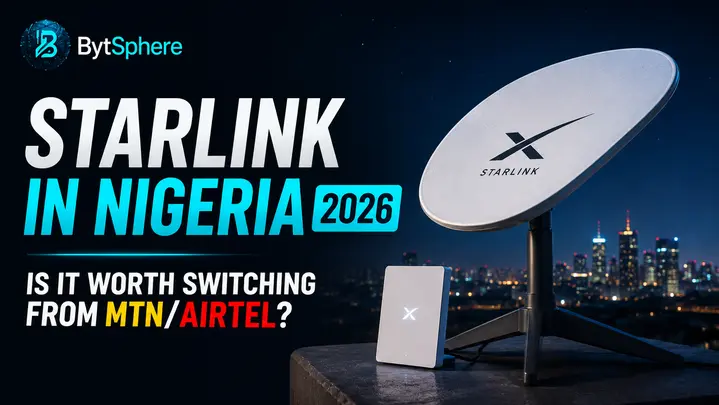
Starlink has generated more curiosity — and more confusion — than almost any internet service in Nigeria's history. Elon Musk's satellite internet promises to deliver fast, reliable connectivity anywhere with a clear view of the sky, bypassing Nigeria's patchy fibre infrastructure and congested mobile towers entirely.
📋 Table of Contents
- What Starlink Actually Is
- Starlink Nigeria Pricing in 2026
- Speed Comparison: Starlink vs MTN vs Airtel vs Fibre
- Full Year-One Cost Comparison Table
- Availability: The Lagos & Abuja Problem
- The Power Problem Nobody Talks About
- Who Should Actually Buy Starlink
- Who Should NOT Buy Starlink
- Competition Coming: Amazon LEO
- Final Verdict
- Frequently Asked Questions
But is it actually worth switching from MTN or Airtel? The honest answer depends heavily on where you live, what you use the internet for, and how much the hardware cost scares you. This guide breaks down the real 2026 numbers — pricing, speed, availability, and hidden costs — so you can make an informed decision instead of relying on hype.
What Starlink Actually Is
Starlink is a satellite-based internet service operated by SpaceX. Unlike traditional satellite internet that uses a few large satellites in geostationary orbit roughly 36,000km above Earth, Starlink uses thousands of small satellites in Low Earth Orbit — approximately 550km above Earth. This proximity means dramatically lower latency than older satellite services, making it usable for video calls, online gaming, and real-time work — something older satellite internet simply couldn't handle.
Starlink is officially licensed and regulated in Nigeria by the Nigerian Communications Commission (NCC), and Nigeria was one of Starlink's first African launch markets. Given unreliable fixed-line infrastructure across much of the country, Starlink has become a genuine connectivity solution for businesses, remote workers, and homes outside major cities.
Starlink Nigeria Pricing in 2026
Starlink pricing in Nigeria has changed significantly since its 2023 launch — and understanding the current structure matters because the numbers you find online are often outdated.
| Item | Price (2026) | Notes |
|---|---|---|
| Standard Kit (official) | ₦450,000 – ₦590,000 | One-time purchase, buy direct from starlink.com/ng |
| Standard Kit (resellers) | ₦750,000 – ₦900,000 | Common when supply is limited or installation is included |
| Mini Kit | ₦318,000 | Lighter, portable, slightly lower speeds |
| Residential Plan | ₦57,000/month | Unlimited data, steady since June 2025 |
| Roam Plan | ₦38,000/month | Works anywhere in Nigeria, popular workaround for waitlisted areas |
| Business Priority Plan | ₦159,000/month | 1–2TB priority data, public IP, only option in congested zones |
Why prices keep shifting: Starlink pricing in Nigeria is denominated in naira but tied to global USD costs. The hardware kit is priced at approximately $368 USD — at ₦1,580/$1 in March 2026, this translates to roughly ₦581,440 before import costs. Every time the naira weakens against the dollar, the real cost of Starlink rises even if the displayed naira figure stays the same.
Speed Comparison: Starlink vs MTN vs Airtel vs Fibre
This is where the Starlink conversation gets genuinely interesting — because on paper, mobile 5G actually wins on raw speed.
| Provider | Typical Speed | Latency | Data Limit |
|---|---|---|---|
| Starlink Residential | 50–100 Mbps | ~25–40ms | Truly unlimited, no FUP throttling |
| MTN 5G (HyNetFlex) | 400 Mbps – 1 Gbps | ~15ms | 200–260GB, then reduced speed |
| Airtel 5G SmartConnect | Fast, but capped | ~15-20ms | ~2GB/day cap, then drops to 64 Kbps |
| MTN FibreX | 25–50 Mbps | ~10-15ms | Unlimited, no throttling |
| Spectranet 4G/5G | 20–40 Mbps | ~20ms | Plan-dependent, battery backup available |
Heavy rain or dense tree cover can occasionally affect Starlink's signal strength — mounting the dish in a completely open area with a clear, unobstructed view of the sky is essential. The Starlink app includes a built-in Obstruction Checker tool you should use before buying, not after installation.
📱 You Might Also Like
Full Year-One Cost Comparison Table
Monthly subscription price alone is misleading. Here's what you'll actually spend in your first year with each option — hardware, installation, and 12 months of subscription combined:
| Provider | Year 1 Total Cost | Includes |
|---|---|---|
| Starlink Residential | ~₦1,134,000+ | ₦450k–590k hardware + ₦57k × 12 months |
| Traditional Fibre ISP | ₦300,000 – ₦400,000 | Installation + 12 months (FiberOne, ipNX, Tizeti) |
| MTN FibreX | ₦180,000 – ₦300,000 | Free installation, no throttling, expanding coverage |
| Airtel Fibre Smart Office | ~₦275,000 | ₦35k install + ₦20k × 12; limited to covered estates |
| 5G (MTN/Airtel Router) | ₦325,000 – ₦500,000 | Router cost + 12 months of unlimited/high-cap plans |
Availability: The Lagos & Abuja Problem
Here's something most Starlink marketing doesn't tell you upfront: residential Starlink sign-ups are currently paused in many high-demand areas of Lagos and Abuja.
As of February 2026, the Residential plan is sold out for new customers in Lagos's most congested zones — Victoria Island, Ikoyi, Lekki, and Surulere — along with similar high-demand areas in Abuja and Port Harcourt. Starlink caps the number of subscribers per coverage cell to maintain speed quality, which means popularity has become its own barrier to entry in exactly the areas most people expect it to work.
Always check starlink.com/ng and enter your exact address before purchasing hardware — availability changes regularly as SpaceX adds satellites and ground infrastructure, and there's no point buying a ₦590,000 kit only to discover your area is sold out.
The Power Problem Nobody Talks About
Starlink's dish and router need constant power to function — and Nigeria's electricity supply is, to put it mildly, unreliable. This is arguably the most overlooked cost in every Starlink comparison online.
Unlike some Nigerian ISPs — Spectranet routers, for example, often include internal batteries that keep your internet running for a few hours when NEPA takes light, without needing a generator. Standard Starlink routers go dark instantly the moment power cuts, unless you've budgeted separately for backup power.
- Standard Starlink kit has no built-in battery backup
- A power outage means your ₦57,000/month "unlimited" internet is completely offline
- Most serious Starlink users in Nigeria pair it with an inverter, UPS, or solar power station — adding significant extra cost
- Spectranet's battery-backed routers are specifically marketed as the better choice for power-challenged areas
Who Should Actually Buy Starlink
- Remote workers and freelancers who depend on video calls, file uploads, and reliable 24/7 connectivity — Starlink's consistency is its biggest genuine advantage
- Businesses in areas without fibre infrastructure — clinics, schools, hotels, warehouses, petrol stations outside major cities
- Farmers and agribusinesses in rural areas who need connectivity for e-commerce, communication, or precision agriculture tools
- Communities in underserved LGAs where the only prior alternative was slow, expensive VSAT or unreliable 4G
- Nigerians in the Northeast (Gombe, Borno, Adamawa, Yobe) where infrastructure gaps are most severe
- YouTube creators and content businesses needing fast, consistent upload speeds regardless of location
- Frequent travellers who move between cities and want internet that follows them (Roam plan)
- Anyone who genuinely hates data caps and is willing to pay a premium for truly unlimited, unthrottled data
Who Should NOT Buy Starlink
- You already have MTN FibreX or Airtel Fibre available at your address — these are cheaper monthly and comparable or faster in practical use for most needs
- You're a light internet user — social media, messaging, occasional browsing — the cost is simply unjustifiable for low-data needs
- Your budget can't comfortably absorb the ₦450,000–₦900,000 upfront hardware cost — this is not a decision to stretch your finances for
- You don't have a UPS, inverter, or generator to keep the router powered during NEPA outages — you'll be paying premium prices for a service that goes dark during blackouts
- You live in central Lagos or Abuja with good existing coverage — Starlink's advantage is weakest exactly where terrestrial infrastructure is strongest
Competition Coming: Amazon LEO
Starlink's monopoly on satellite internet in Nigeria is about to face real competition. Amazon's satellite internet venture, officially rebranded as Amazon LEO (formerly Project Kuiper), received a seven-year landing permit from the Nigerian Communications Commission, effective February 28, 2026 — making it the first credible competitor to Starlink in Nigeria's low-Earth orbit satellite internet market.
Final Verdict
Starlink is not a universal upgrade from MTN or Airtel — it's a specialised tool that solves a specific problem: unreliable or nonexistent internet infrastructure at your specific location.
- Budget under ₦35k/month + you're in a Lagos/Abuja estate with fibre coverage → Choose MTN FibreX or Airtel Fibre
- No fibre coverage at your address + you can afford ~₦700k–₦1.1m upfront and yearly → Choose Starlink Standard
- Frequent traveller who needs portable internet across cities → Choose Starlink Mini + Roam plan (₦318k + ₦38k/month)
- Power-challenged area, moderate speeds acceptable → Choose Spectranet (battery-backed routers)
- Heavy data user with good 5G coverage in your area → Consider MTN 5G HyNetFlex
Are you using Starlink in Nigeria, or considering it? Drop a comment below and share your experience — real user feedback helps other BytSphere readers make better decisions.
Stay tuned to BytSphere for more honest tech and connectivity guides made for Nigerians.
Frequently Asked Questions
How much does Starlink cost in Nigeria in 2026?
Starlink's Residential plan costs ₦57,000/month, unchanged since June 2025. The hardware kit costs ₦450,000–₦590,000 when bought directly from starlink.com/ng, though resellers commonly charge ₦750,000–₦900,000 due to limited supply. A cheaper Roam plan (₦38,000/month) and Mini Kit (₦318,000) are also available for portable use. In total, expect to spend over ₦1,100,000 in your first year including hardware and 12 months of subscription.
Is Starlink faster than MTN or Airtel in Nigeria?
Not necessarily. MTN 5G can deliver 400 Mbps to 1 Gbps in strong coverage zones — significantly faster than Starlink's typical 50–100 Mbps. However, this MTN speed only applies in dense urban 5G zones, and drops dramatically or disappears outside major cities. Starlink's real advantage isn't raw speed — it's consistency. It doesn't degrade from network congestion, doesn't get dug up by construction work, and has no data caps or throttling, unlike Airtel's "unlimited" plans which are often capped around 20 Mbps in the fine print.
Can I use Starlink in Lagos or Abuja right now?
It depends on the specific area. As of February 2026, Residential plan sign-ups are sold out in high-demand zones including Victoria Island, Ikoyi, Lekki, and Surulere in Lagos, plus similar congested areas in Abuja. Starlink caps subscribers per coverage cell to maintain speed quality. If Residential is unavailable at your address, the Business Priority plan (₦159,000/month) still has capacity in these areas, or you can join the residential waitlist at starlink.com. Always check availability at your exact address before purchasing hardware.
Does Starlink work during power outages in Nigeria?
No — not without additional equipment. The standard Starlink kit has no built-in battery backup, meaning it goes offline immediately when power cuts, just like most home electronics. This is a significant consideration in Nigeria given frequent power outages. Most serious Starlink users pair their setup with a UPS, inverter, or solar power station — adding ₦80,000–₦250,000 to the overall cost. In contrast, providers like Spectranet often include internal battery backup in their routers, keeping internet running for a few hours during outages without needing separate backup power.
Is Starlink worth it for a small business in Nigeria?
Often yes, particularly for businesses where downtime costs real money and reliable connectivity is non-negotiable — clinics, hotels, schools, or offices in areas with unreliable fibre or mobile coverage. Starlink's 80–150 Mbps typically handles full team operations without degradation and doesn't go down due to construction work disrupting fibre lines. However, for businesses already served by good fibre in central Lagos or Abuja, traditional fibre ISPs remain cheaper for comparable performance. The Business Priority plan (₦159,000/month) is specifically designed for offices needing higher capacity and priority support.
How do I pay for Starlink in Nigeria?
Starlink subscriptions in Nigeria are typically paid using international debit or credit cards through the official Starlink website. Some local resellers accept naira payments directly, but always confirm payment terms and verify authenticity before purchasing through third-party sellers, especially given the high hardware cost involved. Buying directly from starlink.com/ng is the safest way to confirm current, accurate pricing and avoid potential scams from unofficial resellers.